
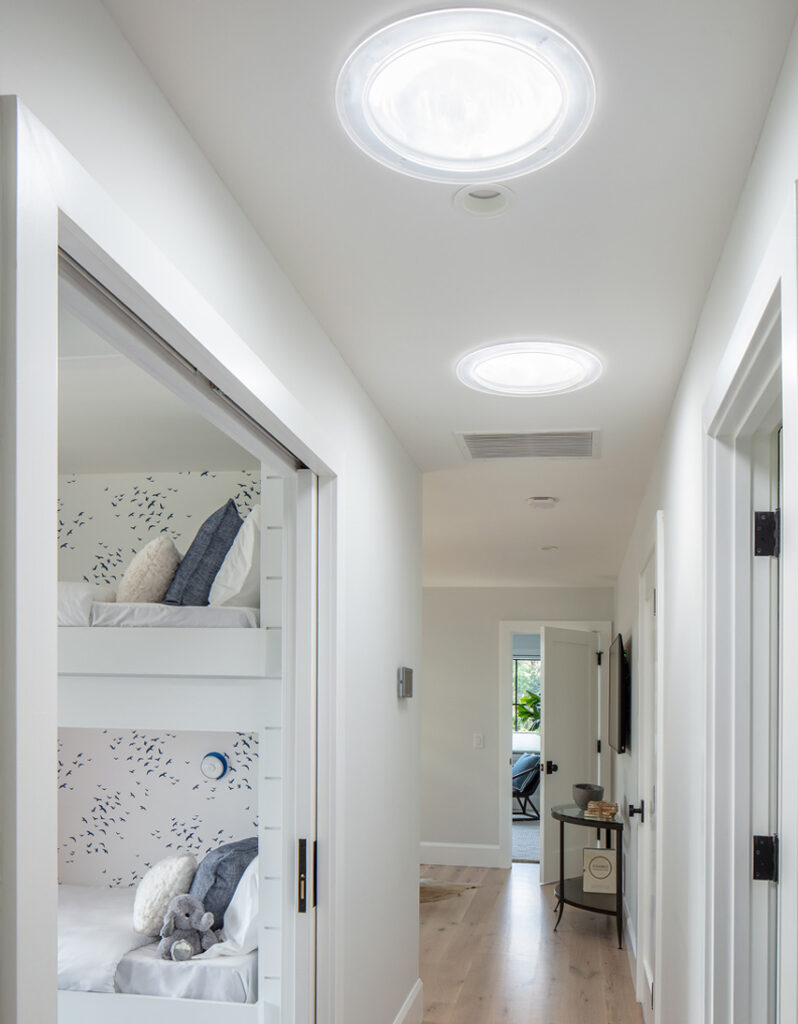
Natural light can completely change how a home feels, yet some of the most frequently used areas in Nepean homes receive very little of it. Interior hallways, bathrooms, walk-in closets, laundry rooms, stair landings, and mudrooms are often located far from exterior walls, leaving homeowners dependent on artificial lighting throughout the day.
Traditional windows are not always practical in these spaces, and installing a full-size skylight may be unnecessary or structurally difficult.
That is where sun tunnels can be particularly effective.
A sun tunnel captures daylight at roof level and transfers it through a reflective tube to a diffuser installed in the ceiling below. VELUX describes its SUN TUNNEL systems as a way to bring daylight into areas where a traditional skylight may not be suitable. Rigid tunnels are generally recommended where there is a relatively straight path between roof and ceiling, while flexible tunnels can work around obstructions in the attic. (Velux)
For homeowners searching for sun tunnels near me, VELUX sun tunnels, residential skylights near me, skylight installer near Ottawa, skylights in Nepean, or VELUX skylight installer near me, choosing the right location is critical to getting the greatest benefit.
Here are some of the best places to consider sun tunnels in dark Nepean homes.
Why Nepean Homes Can Have Dark Interior Spaces
Nepean contains an extensive mix of housing styles and ages.
Some homes were designed when compartmentalized floor plans were more common. Others have been renovated and expanded over the years, creating interior areas farther away from exterior windows.
Homes may contain:
- Central corridors
- Interior bathrooms
- Enclosed staircases
- Deep floor plans
- Windowless laundry rooms
- Walk-in closets
- Interior pantries
Adding conventional windows to these areas can be difficult because there may simply be no exterior wall available.
A sun tunnel approaches the problem vertically.
Instead of trying to bring daylight horizontally through another room, it collects available daylight at the roof and directs it toward the ceiling below.
That makes it particularly useful for upper-floor and single-storey interior spaces.
1. Interior Hallways
Hallways are arguably the best location for residential sun tunnels.
A typical second-floor hallway may connect several bedrooms and bathrooms while having no windows of its own.
During the daytime, every bedroom can be filled with natural light while the hallway remains dark whenever the doors are closed.
A strategically positioned sun tunnel can change that.
The ceiling diffuser distributes daylight into the hallway, potentially reducing the need to switch on artificial lighting every time someone walks through.
This can also improve the overall visual flow of the home.
Instead of moving from a bright bedroom into a dark corridor and back into another bright room, the entire upper level can feel more consistently illuminated.
2. Central Upstairs Landings
The landing at the top of a staircase is another excellent location.
In many two-storey homes, the staircase itself receives some daylight from the main floor, but the upper landing remains relatively dark.
Installing a sun tunnel above the landing can introduce light at the highest point of the circulation area.
Depending on the floor plan, that daylight may spread into:
- The hallway
- Staircase
- Bedroom entrances
- Nearby bathrooms
This means one relatively compact daylighting installation may influence several connected spaces.
For families, that can make the entire second floor feel brighter.
3. Windowless Bathrooms
Bathrooms present one of the most common daylighting challenges.
Homeowners want good lighting, but privacy often limits conventional window options.
An interior bathroom may have no window at all.
A sun tunnel can provide daylight without creating an exterior wall opening or direct sightline.
This makes it particularly useful for:
- Family bathrooms
- Powder rooms
- Interior ensuites
- Small guest bathrooms
The effect can be surprisingly dramatic because bathroom surfaces often reflect light effectively.
White tile, mirrors, glass shower enclosures, light countertops, and painted walls can help distribute the incoming daylight throughout the room.
4. Walk-In Closets
Walk-in closets are another strong candidate.
Most closets have no windows because wall space is needed for shelving and hanging storage.
As a result, homeowners frequently switch on the light even at midday.
A sun tunnel can introduce natural daylight without consuming any wall space.
This has another practical advantage: natural light can make it easier to distinguish clothing colours.
Black, navy, charcoal, and other similar shades can be difficult to differentiate under poor artificial lighting. Daylight generally provides more natural colour rendering.
For a primary bedroom renovation, adding a sun tunnel to the walk-in closet can be a small upgrade that homeowners appreciate every day.
5. Laundry Rooms
Laundry rooms are often positioned wherever the floor plan allows rather than where natural light is best.
In many homes, that means they are located:
- Near an interior hallway
- Beside a bathroom
- On the second floor
- Between bedrooms
- Near a garage
These rooms can feel surprisingly enclosed.
Adding a sun tunnel can make the laundry room feel brighter and more pleasant without sacrificing storage or cabinetry.
Natural daylight can also help when sorting clothing or checking stains.
Because laundry rooms are used frequently, improving their lighting can make a noticeable difference in everyday household routines.
6. Mudrooms Near the Garage
Mudrooms are extremely important in Ottawa homes.
During a Nepean winter, they become collection points for:
- Boots
- Winter coats
- Gloves
- Backpacks
- Hockey equipment
- Wet clothing
Unfortunately, mudrooms are frequently positioned between the garage and interior of the home, where windows may be limited.
That can make an already busy space feel even more confined.
A sun tunnel can brighten the area without taking away valuable wall space needed for hooks, benches, cubbies, and storage.
For families entering and leaving through the garage every day, this can be one of the most practical locations for daylighting.
7. Interior Staircases
Some staircases are positioned deep inside the home.
Even during bright afternoons, they may require artificial lighting.
A sun tunnel positioned near the top of the staircase can allow daylight to enter from above and potentially travel downward.
The exact result depends on:
- Staircase design
- Ceiling height
- Wall configuration
- Interior colours
- Tunnel position
Open staircases tend to allow light to spread more effectively than completely enclosed designs.
For homeowners already renovating a staircase or opening walls around it, considering daylighting at the same time can produce a much more impressive finished space.
8. Kitchen Pantries
Large walk-in pantries have become increasingly popular.
They provide excellent storage but frequently have no windows.
A sun tunnel can illuminate shelves, food storage, and countertops without consuming valuable wall space.
This can be particularly useful in larger kitchen renovations where the pantry is used throughout the day.
Rather than automatically switching on a ceiling fixture whenever someone needs an ingredient, available daylight can provide illumination during daytime hours.
9. Interior Kitchen Areas
Not every kitchen needs a full-size skylight.
Some kitchens already receive reasonable daylight around their windows but have one particularly dark section.
This could include:
- A preparation area
- A breakfast nook
- A connecting corridor
- A pantry entrance
A sun tunnel may provide targeted daylight without requiring the architectural presence of a conventional skylight.
For larger kitchens, homeowners can even combine traditional skylights with sun tunnels to create more balanced daylight throughout the surrounding spaces.
10. Home Offices Without Exterior Windows
Remote and hybrid work have changed how homeowners use spare rooms.
Some rooms that were originally intended as storage areas or dens are now permanent home offices.
If that room lacks exterior windows, spending an entire workday under artificial lighting can make it feel enclosed.
Where roof and attic conditions permit, a sun tunnel can introduce daylight without using valuable wall space.
That leaves walls available for:
- Desks
- Shelving
- Storage
- Monitors
- Artwork
It can be an effective way to improve an otherwise dark workspace without undertaking a major renovation.
11. Interior Powder Rooms
Powder rooms are usually compact, making them excellent candidates for sun tunnels.
A relatively small amount of natural daylight can make a major visual difference in a small room.
Because powder rooms typically do not require a large window or exterior view, the daylight provided by a ceiling diffuser may be all that is needed.
This can make the room feel brighter, cleaner, and more welcoming to guests.
12. Reading Nooks and Small Interior Spaces
Some homes have small spaces that do not fit neatly into a traditional room category.
Examples include:
- Reading corners
- Upstairs alcoves
- Craft spaces
- Small play areas
- Interior seating areas
These spaces are often overlooked during lighting design.
A sun tunnel can transform an unused dark corner into a much more appealing part of the home.
13. Enclosed Entry Areas
Some Nepean homes have entryways where the front door and surrounding architecture provide relatively little daylight.
If the foyer is located beneath an accessible roof section, a sun tunnel may help brighten the entrance.
A naturally illuminated entryway can create a stronger first impression while reducing daytime dependence on overhead lighting.
14. Bungalow Hallways
Nepean’s bungalow-style homes can be especially well suited to sun tunnels.
Because the main-floor ceiling is often directly beneath attic and roof space, there may be a relatively straightforward route from roof to ceiling.
Central hallways in bungalows frequently connect:
- Bedrooms
- Bathrooms
- Living areas
Yet they may have no exterior windows.
A sun tunnel can bring daylight directly into the centre of the floor plan.
Rigid vs Flexible Sun Tunnels
Choosing the location is only part of the process.
The route between the roof and ceiling matters too.
Rigid Sun Tunnels
VELUX recommends rigid tubes where there is a relatively straight, unobstructed route between the roof and ceiling. Its rigid systems use highly reflective tubing and are particularly suited to longer runs. (Velux)
These can be excellent for hallways, bathrooms, and closets where roof placement aligns well with the desired ceiling diffuser location.
Flexible Sun Tunnels
Flexible tubes provide more installation flexibility.
They can bend around attic obstacles such as framing, pipes, and other components, making them useful where a straight route is unavailable. VELUX specifically identifies their ability to navigate attic obstructions as a key advantage. (Velux)
An installer should inspect the attic before determining which configuration is appropriate.
Keep the Route Efficient
A sun tunnel does not simply need available roof space.
The route from the roof collector to the ceiling diffuser should also be considered carefully.
Roof framing, plumbing vents, HVAC components, wiring, and other attic obstructions can influence the final location.
This is why a homeowner should avoid choosing the exact ceiling position without first checking conditions above it.
Moving the diffuser slightly may allow a much more efficient tunnel path.
Consider Where Daylight Is Needed Most
The best location is not necessarily the darkest room.
Instead, homeowners should consider which dark area is used most frequently.
For example, a storage closet may be completely dark, but perhaps it is opened only once per week.
Meanwhile, a second-floor hallway may be used dozens of times every day.
Prioritizing frequently used areas usually produces greater everyday value.
A useful starting order is often:
- Main hallways
- Bathrooms
- Stair landings
- Laundry rooms
- Mudrooms
- Walk-in closets
- Pantries
The final priority will depend on the family and floor plan.
Light-Coloured Interiors Can Enhance the Effect
Interior finishes influence how daylight is perceived.
Light-coloured walls and ceilings reflect more light throughout a space.
This means a sun tunnel installed in a hallway with white or light-neutral finishes may appear particularly effective.
Dark paint, cabinetry, or flooring absorbs more light.
That does not mean sun tunnels cannot work in darker rooms, but placement and sizing become even more important.
Sun Tunnels and Energy Efficiency
One of the practical benefits of introducing daylight into previously dark rooms is the potential to reduce daytime dependence on electric lighting.
Natural Resources Canada recommends considering energy-efficient products when choosing windows, doors, and skylights and notes that efficient models can help reduce household energy use. It also recommends professional installation so these products perform as intended. (Natural Resources Canada)
Sun tunnels are particularly useful because they target areas where lights may otherwise remain on throughout much of the day.
Sun Tunnels vs Traditional Skylights
The two products solve different problems.
A traditional skylight is often the stronger choice when homeowners want:
- A view of the sky
- Large amounts of daylight
- An architectural feature
- Ventilation from an operable model
These are commonly installed in kitchens, living rooms, great rooms, and primary bathrooms.
A sun tunnel is generally better suited to:
- Hallways
- Closets
- Laundry rooms
- Pantries
- Powder rooms
- Small bathrooms
Many Nepean homes can benefit from using both rather than choosing one exclusively.
What About Rooms Below Another Floor?
Sun tunnels are generally most straightforward where there is a practical path from the roof to the target ceiling.
If another occupied floor sits directly above the desired room, routing the tunnel becomes considerably more complicated because the tube must pass through that floor.
This is why upper-floor rooms and single-storey areas are usually the strongest candidates.
A professional site assessment can determine what is practical for a specific property.
Installation Must Be Planned From the Roof Down
The finished ceiling diffuser may look similar to a conventional light fixture, but the installation involves the roof.
VELUX describes the basic process as inspecting the attic and framing, creating the roof opening, installing the roof components and flashing, connecting the reflective tunnel, and then installing the interior diffuser. (Velux)
Because the installation penetrates the roofing system, proper flashing and weather protection are essential.
This matters especially in Ottawa’s climate.
Ottawa Weather Makes Professional Installation Important
Nepean homes experience:
- Heavy snow
- Ice
- Freeze-thaw cycles
- Spring rainfall
- Summer storms
Every roof penetration must be integrated properly with the surrounding roofing system.
The objective is not simply to deliver daylight.
The installation must also preserve the performance of the roof and building envelope.
Natural Resources Canada specifically advises homeowners to hire trained professionals for window, door, and skylight installations so products can perform properly. (Natural Resources Canada)
Plan Sun Tunnels During Roof Replacement
If a Nepean homeowner is already planning to replace the roof, it can be an excellent time to investigate sun tunnels.
The installer can evaluate:
- Roof condition
- Potential collector locations
- Attic obstacles
- Interior diffuser placement
- Flashing requirements
Coordinating daylighting improvements with roof work can make the overall project more efficient.
Renovations Are Another Excellent Opportunity
Sun tunnels can also be considered during:
- Bathroom renovations
- Hallway renovations
- Laundry room upgrades
- Kitchen renovations
- Attic improvements
- Interior remodelling
If ceilings are already being opened or refinished, planning the diffuser and tunnel route becomes easier.
This also allows lighting design to account for the new source of daylight.
Nepean Homes Need Individual Solutions
A home in Centrepointe may have completely different daylighting challenges from a bungalow elsewhere in Nepean.
Roof pitch, attic configuration, orientation, tree coverage, ceiling height, and room layout all influence the result.
That means there should never be a one-size-fits-all approach to sun tunnel installation.
The best system begins with identifying the dark areas homeowners actually use, then examining the roof and attic to determine the most effective route.
Bringing Daylight Into the Darkest Parts of Nepean Homes
Some of the most valuable daylighting improvements are not found in large living rooms or dramatic kitchens. They are found in the everyday spaces homeowners walk through and use repeatedly.
A dark upstairs hallway can become naturally illuminated. A windowless bathroom can feel more open without sacrificing privacy. A walk-in closet can finally have useful daytime light. A laundry room or mudroom can feel less like a utility space and more like an intentional part of the home.
For homeowners throughout Nepean and the wider Ottawa area, sun tunnels provide a practical way to introduce daylight where conventional windows or full-size skylights may not make sense.
The strongest locations are typically interior hallways, upstairs landings, bathrooms, walk-in closets, laundry rooms, mudrooms, pantries, staircases, and other enclosed areas directly beneath accessible roof space.
For anyone searching for sun tunnels near me, VELUX sun tunnels, residential skylights near me, skylight installer near Ottawa, VELUX skylights Canada, or VELUX skylight installer near me, the most important first step is determining where daylight would make the greatest difference every single day.
When the location, tunnel route, roof integration, and installation are carefully planned, a relatively compact sun tunnel can completely change one of the darkest areas of a Nepean home.