
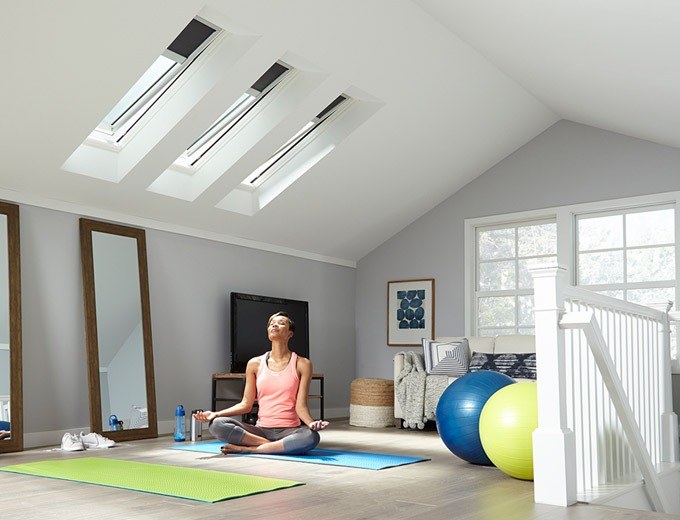
A well-planned skylight can completely change how a home feels. Rooms that once depended heavily on artificial lighting can become brighter, more inviting, and visually connected to the outdoors. In Kemptville, where homes range from established properties near the historic downtown core to newer residential developments throughout North Grenville, skylights can be incorporated into many different architectural styles.
Successful skylight installation, however, involves much more than selecting a window and creating an opening in the roof.
Roof pitch, orientation, skylight size, glazing, flashing, insulation, waterproofing, interior ceiling design, ventilation, and Ottawa Valley weather conditions all affect the finished result. Homeowners searching for skylights near me, VELUX skylight installation, VELUX skylights Canada, VELUX skylight sizes and prices, or a VELUX skylight installer near Kemptville should therefore begin with careful planning.
VELUX Canada provides separate installation instructions for deck-mounted, curb-mounted, flat-roof, commercial, and SUN TUNNEL® products, demonstrating why the correct installation method needs to match both the selected skylight and the roof. (VELUX Canada)
Here are some of the most important considerations Kemptville homeowners should understand before beginning a residential skylight project.
Start With the Room, Not the Skylight
One of the most common mistakes is beginning with a particular skylight model or size.
The better starting point is the room.
Homeowners should first ask what they are trying to accomplish.
Does a kitchen need more daylight over the island?
Is an upstairs hallway dark throughout the afternoon?
Would a bathroom benefit from both daylight and ventilation?
Does a vaulted living room need a stronger architectural feature?
Is a walk-in closet too small to justify a conventional skylight?
Answering these questions makes it easier to determine whether the project requires a fixed skylight, venting skylight, multiple skylights, or a sun tunnel.
A product should solve the home’s daylighting problem rather than forcing the room to accommodate a predetermined product.
Identify Where Natural Light Is Missing
A home does not necessarily have to be poorly designed to contain dark spaces.
Some rooms are naturally harder to illuminate because they sit toward the centre of the floor plan.
This can happen in:
- Kitchens
- Bathrooms
- Interior hallways
- Staircases
- Walk-in closets
- Laundry rooms
- Home offices
- Family rooms
- Finished attic spaces
Kemptville’s mix of older and newer homes means these situations can occur for very different reasons.
An established home may have smaller windows or a floor plan that was designed before open-concept living became common.
A newer house may have plenty of large exterior windows but still contain deeper interior spaces that daylight cannot easily reach.
Skylights create another route for natural light by bringing it through the roof.
Decide Between a Skylight and a Sun Tunnel
Not every dark room needs a conventional skylight.
A traditional skylight creates a larger opening and can provide a direct view toward the sky. Depending on the model, it can also provide ventilation.
A sun tunnel is designed primarily to carry daylight from the roof into a smaller interior space through reflective tubing.
Sun tunnels can be particularly practical for:
- Hallways
- Small bathrooms
- Closets
- Pantries
- Laundry rooms
- Interior corridors
A larger kitchen or living area may benefit more from a traditional skylight.
The best Kemptville daylighting plan may even combine both systems.
For example, VELUX skylights could brighten an open kitchen while a SUN TUNNEL provides daylight to the interior hallway beside it.
Choose the Right Skylight Type
Once the room and daylighting objective have been established, homeowners can begin considering skylight types.
Fixed Skylights
Fixed skylights do not open.
Their primary purpose is introducing natural light.
They can work well in:
- Living rooms
- Family rooms
- Dining areas
- Stairwells
- High ceilings
For spaces that already have sufficient ventilation, fixed skylights can provide a relatively straightforward daylighting solution.
Venting Skylights
Venting skylights can be opened, allowing them to provide daylight as well as additional airflow.
These can be particularly useful in:
- Kitchens
- Bathrooms
- Upper-storey rooms
- Vaulted spaces
VELUX Canada offers manual, electric, and solar-powered venting skylight options. Homeowners can explore the company’s current installation resources through its official Canadian site. (VELUX Canada)
The appropriate choice depends on accessibility, room use, roof configuration, and homeowner preferences.
Consider How High the Skylight Will Be
Accessibility is sometimes overlooked during the initial design stage.
A manually operated skylight may be perfectly practical over a relatively low ceiling.
It becomes much less convenient when positioned high above a vaulted living room or staircase.
Kemptville homeowners with cathedral ceilings or high open spaces may therefore want to consider powered operation.
The decision should happen before installation because the selected product and supporting requirements may differ.
Choose Skylight Size Carefully
People frequently search for VELUX skylight sizes, VELUX skylights sizes and prices, and VELUX skylight price when beginning their research.
Size matters, but the largest skylight is not necessarily the best one.
A properly sized skylight should complement:
- Room dimensions
- Ceiling height
- Existing windows
- Roof framing
- Interior layout
- Desired brightness
- Roof orientation
A small skylight in a large great room may not produce the effect the homeowner expects.
An unnecessarily large skylight in a compact room can also create excessive brightness or solar gain.
Sometimes two smaller skylights create better daylight distribution than one oversized unit.
Think About Skylight Placement
Placement has a major effect on how daylight moves through a room.
A skylight positioned directly over the centre of a room will create a different effect from one placed along an exterior wall.
In a kitchen, skylights can be positioned to help illuminate:
- Islands
- Preparation areas
- Dining spaces
- Walkways
In a living room, they can draw attention toward:
- A fireplace
- Seating area
- Feature wall
- Vaulted ceiling
A skylight should be treated as an architectural element rather than simply a hole for sunlight.
Consider Roof Orientation
The direction the roof faces influences when and how much sunlight reaches a skylight.
Different roof slopes experience different solar exposure throughout the day.
Homeowners should consider whether they want:
- Softer daylight
- Stronger morning light
- Greater afternoon illumination
- More consistent ambient light
Orientation is also connected to solar heat gain.
Natural Resources Canada explains that glazing selection affects thermal performance and that solar heat gain coefficient is an important consideration when selecting fenestration products. (Natural Resources Canada)
That is particularly relevant when skylights are installed on roof slopes receiving substantial direct sun.
Mature Trees Can Affect the Result
Kemptville and the broader North Grenville area contain many properties surrounded by mature vegetation.
Trees can provide welcome shade, but they can also influence skylight performance.
A skylight positioned beneath a heavily shaded section of roof may provide a very different daylight experience from one installed on a more exposed roof plane.
Seasonal changes matter too.
A deciduous tree may create significant shade during summer but allow much more sunlight through after leaves fall.
A property-specific assessment should therefore consider surrounding vegetation rather than looking only at the roof itself.
Inspect the Roof Before Choosing the Location
The ideal interior position and the ideal roof position do not always align.
Before installation, the roof and attic should be inspected for potential conflicts such as:
- Rafters
- Trusses
- Plumbing vents
- Wiring
- HVAC ducts
- Chimneys
- Roof valleys
- Other roof penetrations
Homeowners may want the skylight centred perfectly above a kitchen island, for example, but structural framing may require a different position.
An experienced installer can determine whether the desired location is practical or whether another placement would achieve a similar daylighting effect with fewer structural changes.
Understand Deck-Mounted Skylights
Deck-mounted skylights are installed relatively close to the roof deck.
This creates a lower-profile exterior appearance.
VELUX provides dedicated deck-mounted flashing systems designed for different roofing applications. The company’s installation guidance emphasizes that proper flashing is required with its deck-mounted skylights. (VELUX Canada)
Deck mounting may be appropriate for many sloped residential roof applications, but it is not automatically suitable for every roof.
Understand Curb-Mounted Skylights
A curb-mounted skylight sits on a raised curb built above the roof.
This approach may be used for certain roof types, replacement projects, or other installation conditions.
Choosing between curb-mounted and deck-mounted designs depends on:
- Roof slope
- Roofing material
- Existing openings
- Skylight model
- Roof construction
Homeowners should not select mounting type solely based on appearance.
The roof should determine the appropriate installation method.
Flashing Is One of the Most Important Details
Skylight installation is fundamentally a water-management project.
The glass gets most of the attention, but flashing is one of the most important parts of the system.
Flashing directs water around the skylight and back onto the roof surface.
VELUX offers specific flashing systems for different roofing materials, including shingles, shakes, tile, and metal applications. Its guidance notes that step flashing pieces are designed to integrate with roofing materials to provide proper water drainage. (VELUX Canada)
Improvised flashing details should not be treated as a substitute for an installation system designed for the roof and skylight.
Ottawa Valley Weather Makes Waterproofing Critical
Kemptville experiences the same challenging seasonal conditions found throughout Eastern Ontario.
A skylight has to handle:
- Heavy rain
- Snow
- Ice
- Freeze-thaw cycles
- Strong winds
- Hot summers
- Cold winters
Water can behave very differently on a roof during a January thaw than during a summer rainstorm.
Snow that accumulates above a skylight can melt and refreeze.
Rain can be driven by wind.
Ice can form around roof details.
This is why waterproofing and roof integration should never be treated as minor parts of a skylight installation.
Insulate the Skylight Properly
Heat loss and condensation are important considerations in Canadian climates.
Natural Resources Canada specifically advises that skylight curbs and interior tunnels should be properly insulated and air sealed to help reduce condensation. It also notes that exterior seals and flashing must be maintained to keep water out. (Natural Resources Canada)
This means the installation needs to address more than the exterior roof.
The inside of the opening matters too.
A poorly insulated shaft can become a cold surface during winter.
That can contribute to condensation even if the exterior skylight itself is performing correctly.
Air Sealing Matters Too
Insulation and air sealing work together.
Warm interior air should not be allowed to move freely into colder sections of the skylight assembly.
During a Kemptville winter, the temperature difference between indoor and outdoor air can be substantial.
Air leakage can therefore affect:
- Comfort
- Condensation
- Energy performance
- Moisture behaviour
A quality installation should integrate the skylight into the home’s thermal and air-control layers.
Choose Energy-Efficient Glazing
Canadian homeowners should also consider the energy performance of the skylight itself.
Natural Resources Canada recommends choosing energy-efficient skylights and specifically notes that features such as low-emissivity coatings, insulated frames, and improved glazing can contribute to better performance and reduced condensation. (Natural Resources Canada)
The agency also states that ENERGY STAR-certified skylights are approximately 35% more energy efficient than average skylights. (Natural Resources Canada)
Energy performance should therefore be considered alongside size and appearance.
Don’t Ignore Summer Heat
Kemptville winters understandably receive plenty of attention, but summer conditions matter too.
A skylight receiving direct sunlight for long periods can contribute to unwanted heat gain.
Natural Resources Canada notes that glazing characteristics, including solar heat gain coefficient, influence how much solar energy passes through glazing. (Natural Resources Canada)
This is another reason orientation and glazing selection should be considered together.
The goal should be useful natural light without creating unnecessary discomfort.
Consider Skylight Shades During Planning
Shades can give homeowners better control over brightness and heat.
They may be particularly useful in:
- Bedrooms
- Home offices
- Media rooms
- South-facing spaces
- West-facing spaces
It is often easier to consider shade compatibility while selecting the skylight rather than treating it as an afterthought.
Flat Ceilings Can Still Accommodate Skylights
Many homeowners assume skylights only work with vaulted ceilings.
That is not the case.
A skylight installed above a flat ceiling can use a light shaft to connect the roof opening to the room below.
The shaft itself affects how daylight spreads through the room.
A flared shaft can help distribute light across a wider interior surface.
A narrower vertical shaft produces a more concentrated beam of daylight.
The shape of the shaft should therefore be considered as part of the daylight design.
Vaulted Ceilings Create Different Opportunities
Vaulted ceilings can allow the skylight to connect more directly with the roof plane.
This can create a dramatic architectural effect.
Kemptville homes with:
- Cathedral ceilings
- Loft spaces
- Great rooms
- Upper-floor additions
may be especially well suited to this type of installation.
A skylight can emphasize ceiling height while creating changing patterns of natural light throughout the day.
Plan Skylights During Kitchen Renovations
Kitchen renovations are an excellent time to consider skylights.
If the kitchen is already being redesigned, skylight placement can be coordinated with:
- Island position
- Cabinetry
- Pendant lighting
- Range hood placement
- Ceiling fixtures
- Structural framing
Imagine a large kitchen island positioned in the centre of a Kemptville home.
Exterior windows may provide plenty of daylight along the perimeter but leave the island noticeably darker.
A carefully positioned skylight can bring daylight directly into that central workspace.
Consider Skylights for Bathroom Renovations
Bathrooms are another strong application.
Large wall windows are not always desirable because of privacy.
A skylight can introduce natural light from above while preserving exterior wall privacy.
If ventilation is also desired, a venting skylight may be worth considering.
The selected solution should complement—not replace—any mechanical ventilation required for the room.
Use Skylights to Brighten Staircases
Central staircases can be difficult to illuminate with conventional windows.
A skylight above the upper landing can allow daylight to travel downward into the stairwell.
In an open staircase, that light may also reach adjacent rooms.
This can make one skylight useful across several connected spaces.
Consider Skylights for Home Offices
Home offices are increasingly common in Kemptville homes.
Some have been created from spare bedrooms, loft spaces, or other rooms that were not originally designed for full-day use.
A skylight can add another source of natural light where roof conditions permit.
However, glare should be considered carefully if computer screens are positioned beneath or opposite the opening.
Placement and shading therefore matter as much as brightness.
Coordinate Installation With Roof Replacement
If roof replacement is already planned, it can be an excellent time to consider adding or replacing skylights.
Roofing materials will already be removed in relevant areas, allowing the skylight and new roof assembly to be integrated as part of the same project.
For homes with existing older skylights, reroofing is also a sensible time to evaluate whether those units should remain.
Replacing an aging skylight shortly after installing a new roof could mean disturbing recently completed roofing.
Planning the two projects together can therefore make practical sense.
Evaluate Existing Skylights Before Reusing Them
Not every existing skylight needs replacement.
However, an older unit should be evaluated before surrounding roofing is replaced.
Things to inspect include:
- Glazing condition
- Frame condition
- Flashing
- Signs of leakage
- Cloudiness between panes
- Interior staining
- Drafts
- Previous repairs
A skylight may still perform adequately, or replacement may be the more practical long-term choice.
The decision should be based on condition rather than age alone.
Don’t Assume Every Water Stain Means a Bad Skylight
Water staining near a skylight understandably causes concern.
But the skylight itself may not always be the source.
Water can originate from:
- Surrounding shingles
- Flashing
- Underlayment
- Roof valleys
- Condensation
- Nearby penetrations
A professional inspection should identify the cause before replacement begins.
Replacing a skylight without correcting the actual water-entry point may leave the problem unresolved.
Understand Condensation
Condensation is another commonly misunderstood issue.
Moisture on the interior surface of a skylight may be related to:
- Indoor humidity
- Exterior temperature
- Ventilation
- Insulation
- Air leakage
Natural Resources Canada warns that skylights can experience condensation around frames, curbs, or tunnels and recommends proper insulation and air sealing. (Natural Resources Canada)
Moisture trapped between glazing layers, however, may indicate a different type of issue.
Diagnosis should happen before assumptions are made.
Think About Interior Finishing
The interior work is easy to underestimate.
Depending on the project, installation may require:
- Framing
- Drywall
- Insulation
- Air sealing
- Taping
- Sanding
- Priming
- Painting
A technically successful roof installation can still look unfinished if the interior work is poorly planned.
Homeowners should therefore understand what portion of interior finishing is included in their skylight installation.
Consider Multiple Skylights for Large Rooms
One large skylight is not always the most effective approach.
Multiple skylights can create more balanced daylight across wide rooms.
For example:
Two skylights could run above a long kitchen island.
Three smaller skylights could follow the slope of a vaulted ceiling.
A pair of skylights could frame a fireplace or dining area.
The best arrangement depends on room proportions and roof framing.
Use Skylights to Highlight Architectural Features
Skylights can be placed intentionally to emphasize important parts of a room.
Natural light might be directed toward:
- Stone fireplaces
- Kitchen islands
- Feature walls
- Freestanding tubs
- Staircases
- Dining tables
- Reading areas
This approach is especially effective when skylights are included early in a renovation or new-build design.
Instead of simply brightening the room, they become part of the architecture.
Think About Kemptville’s Established Homes
Kemptville’s established residential areas contain homes from many periods.
Older properties may have:
- Smaller attic spaces
- Previous additions
- Modified rooflines
- Older framing systems
- Renovation history that is not immediately visible
That makes an attic and roof inspection particularly important.
A ceiling may appear straightforward from inside the house while concealing complex framing above it.
Think About Newer North Grenville Homes
New construction presents different opportunities.
Newer homes throughout North Grenville may have:
- Larger open-concept layouts
- Deeper floor plans
- Large kitchens
- Second-floor laundry rooms
- Walk-in closets
- Interior bathrooms
Even with generous exterior windows, these interior spaces can remain surprisingly dark.
Sun tunnels and skylights can be used selectively to bring daylight into those areas without changing exterior wall layouts.
Kemptville’s Local Character Matters
Kemptville’s combination of historic character and ongoing residential growth makes it different from many Ottawa suburbs.
Homes near the downtown area and around landmarks such as the South Branch of the Rideau River may have very different architectural characteristics from newer subdivisions on the community’s outskirts.
Properties throughout the wider North Grenville area can also include:
- Rural homes
- Larger lots
- Mature trees
- Custom homes
- Farmhouse-inspired designs
- New suburban construction
These differences affect roof orientation, shading, roof complexity, and the best opportunities for skylight placement.
There should therefore be no one-size-fits-all skylight solution for Kemptville.
Avoid Selecting a Skylight Based on Price Alone
Searches for skylights near me cost, VELUX skylight price, and VELUX skylights sizes and prices are understandable.
However, product price represents only part of the project.
Installed cost can depend on:
- Skylight model
- Dimensions
- Fixed or venting operation
- Roof height
- Roof slope
- Roofing material
- Accessibility
- Flashing
- Structural modifications
- Light-shaft depth
- Interior finishing
- Electrical requirements
- Number of skylights
- Existing skylight removal
Two homeowners purchasing the same skylight could therefore receive very different installation estimates.
Professional Installation Matters
Natural Resources Canada specifically recommends professional installation for windows, doors, and skylights, noting that trained installation helps these products perform properly. (Natural Resources Canada)
VELUX Canada likewise maintains a network of trained skylight installers who can assist with product sizing, accessories, and installation. (VELUX Canada)
For Kemptville homeowners, professional installation is particularly important because the project affects the roof itself.
Measurements, flashing, waterproofing, insulation, and interior integration all need to work together.
Questions to Ask Before Installation
Before moving forward, homeowners should ask:
- What room needs more daylight?
- Is ventilation also needed?
- Would a skylight or sun tunnel work better?
- What skylight size suits the room?
- What roof direction is best?
- Are nearby trees creating shade?
- Is the ceiling flat or vaulted?
- What is located in the attic above the room?
- Is the roof being replaced soon?
- Which flashing system is required?
- How will the shaft be insulated?
- What interior finishing is included?
- Would shades be useful?
- Is manual operation practical?
- Would multiple skylights provide better coverage?
Answering these questions before work begins can prevent expensive design changes later.
Finding a Skylight Installer Near Kemptville
Homeowners searching for a VELUX skylight installer near me, skylights near Kemptville, or residential skylights near me should look for more than someone capable of cutting a roof opening.
A complete installation should consider:
- Daylighting goals
- Product selection
- Roof framing
- Roof pitch
- Roofing material
- Flashing
- Waterproofing
- Insulation
- Air sealing
- Interior finishing
VELUX provides dedicated installation documentation for different skylight types and flashing systems, reinforcing the importance of matching installation details to the selected product. (VELUX Canada)
Creating a Better Daylighting Plan for Kemptville Homes
The best skylight projects begin before installation day.
Homeowners should think about how daylight currently enters the property, where it disappears, and which rooms would benefit most from an overhead source.
A fixed skylight might transform a dark family room.
A venting skylight might provide daylight and additional airflow in a bathroom.
Several skylights might brighten a large open-concept kitchen.
A sun tunnel could illuminate a hallway that has no direct access to an exterior wall.
Every solution starts with the same principle: daylight should be planned around the home.
For Kemptville homeowners researching VELUX skylights Canada, VELUX skylight installation, VELUX skylight sizes, VELUX skylights sizes and prices, replacement skylights near me, skylights near me cost, or a trusted VELUX skylight installer near Kemptville, professional planning is just as important as the skylight itself.
Roof compatibility, correct sizing, proper flashing, insulation, air sealing, glazing, orientation, and interior design all contribute to long-term performance.
A skylight should not simply brighten a room on installation day. When properly selected and professionally integrated into the roof, it should become a lasting architectural feature that helps natural light reach deeper into a Kemptville home for years to come.